Drop-Proof Kids Tablet TCO: How MIL-STD-810H Cuts 5-Year School Fleet Costs
A drop-proof kids tablet built to MIL-STD-810H with a shatter-resistant screen and reinforced port armor can cut a school’s 5-year 1:1 device fleet total cost of ownership (TCO) by 30-40% versus a standard consumer-grade tablet. The saving is almost entirely operational: in a typical K-12 or early-childhood rollout, cracked screens and broken charging/USB ports account for 50-70% of all device repairs, and every one of those incidents is an out-of-warranty cost plus admin time. Specifying drop resistance into your OEM/ODM sourcing decision up front is the single most reliable way to reduce that drain — far more than negotiating a lower unit price.
For a school district, retailer, or education-tab ODM planning a 1:1 deployment, the hardware cost you pay at order time is only one line of the real bill. Total cost of ownership over a 5-year lifecycle includes repairs, replacements, accessories, IT admin time, insurance, and disposal. When 50-70% of repairs come from physical damage — not from failures — durability engineering is not a “nice-to-have”; it is the TCO lever with the biggest measurable impact.
The hidden cost most buyers underestimate
Most procurement RFPs for kids tablets compare unit price, CPU, RAM, and screen size. Almost none compare damage rate — yet that is what decides the 5-year bill. Industry service data for education devices consistently shows the top failure causes are:
| Failure cause | Share of repairs | Typical out-of-warranty cost |
|---|---|---|
| Cracked / shattered screen | 30-40% | $50-120 per unit |
| Broken charging / USB-C port | 15-25% | $30-80 per unit |
| Damaged casing / hinge | 10-15% | $20-60 per unit |
| Battery / power failure | 5-10% | $40-90 per unit |
Add to each repair a service event of 20-40 minutes of IT admin time and device downtime. For a 1,000-device fleet, reducing the damage rate by even 20% can save tens of thousands of dollars in year one alone — more than the entire unit-price difference you might win by bargaining a few dollars off the bill.
What “drop-proof” actually means in a kids tablet spec
Durability is an engineering specification, not a marketing word. When you source from an OEM/ODM, ask for concrete, testable claims rather than adjectives. The three components that most affect real-world survival are:
- Drop test standard (MIL-STD-810H, Method 516.8) — the device survives repeated drops from a defined height onto concrete. A kids tablet that holds at a 1.2-1.5 m drop height onto a hard floor is meaningfully more survivable than one only rated for a 0.8 m desk drop. Require the test report, not just the claim.
- Shatter-resistant screen — a laminated, edge-reinforced glass (or a shield film) that absorbs impact instead of spider-cracking. This is the single highest-impact upgrade because screen damage is the #1 repair.
- Port and corner armor — reinforced USB-C connector mounting and shock-absorbing corner bumpers. Ports fail from repeated cable tugs; corners fail from drops.
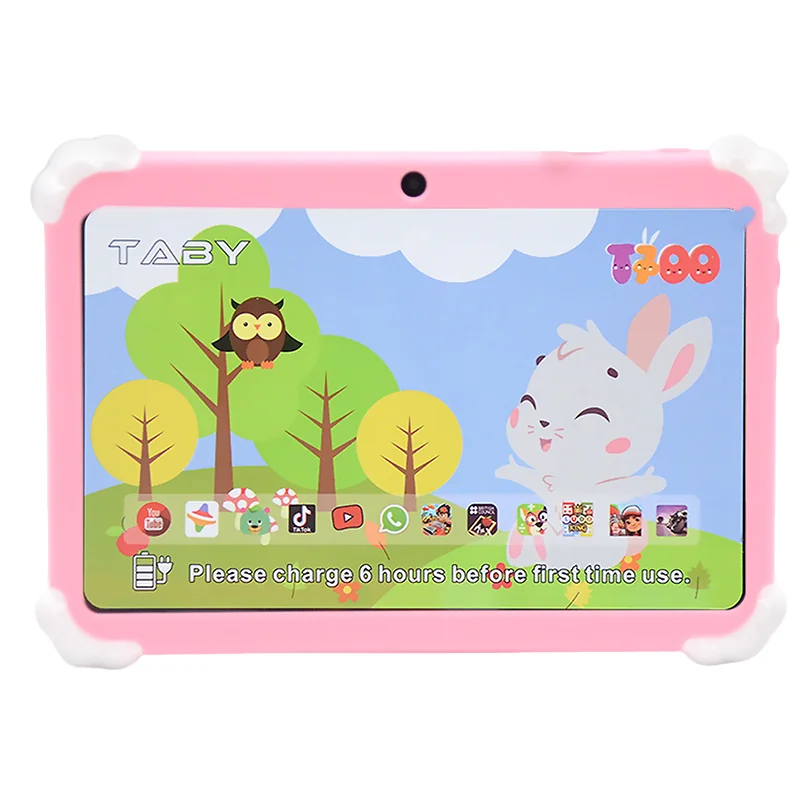
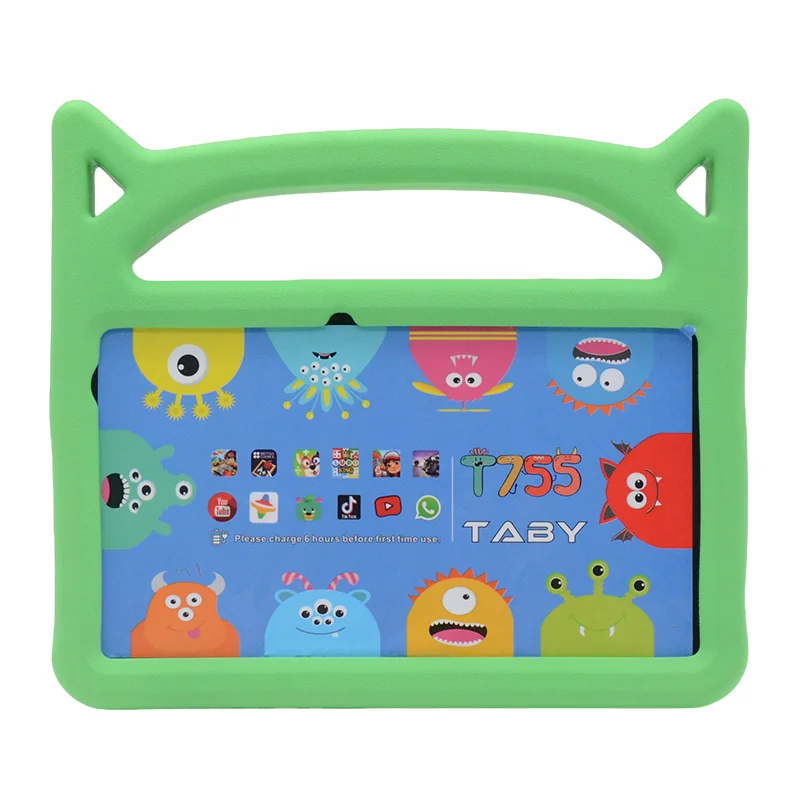
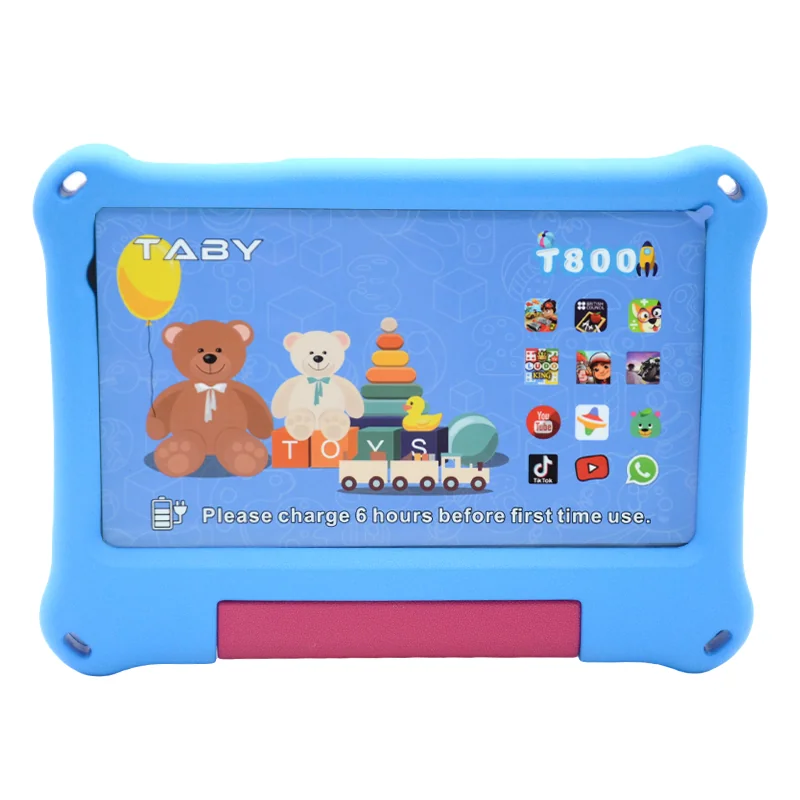
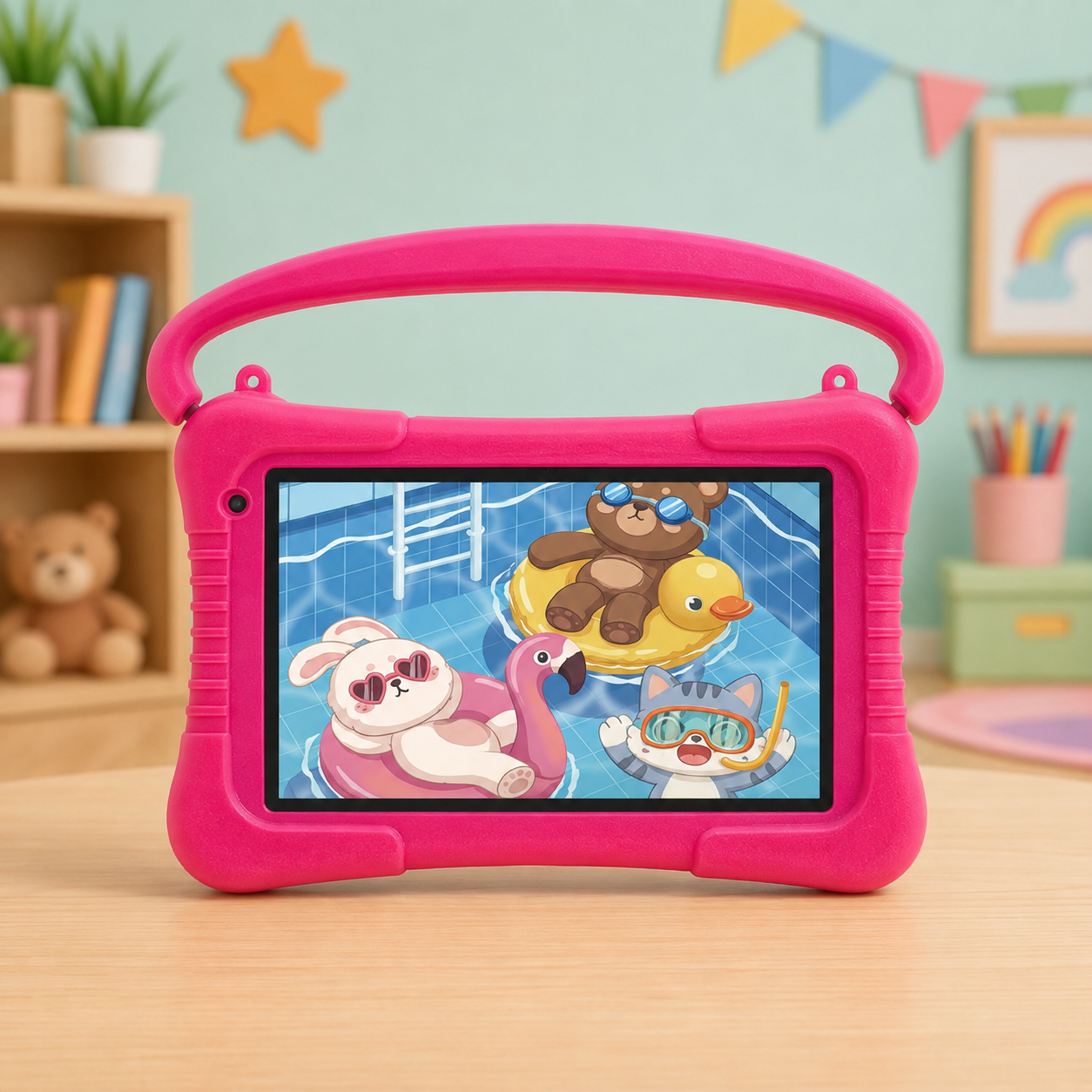
For younger children, an integrated rugged bumper case (rather than a separate accessory) is usually a better choice — it cannot be removed or lost, and it is factory-tested with the device. Our Wintouch kids series such as the T700, T710 and T730 ship with such cases designed for a school environment.
Spec comparison: what to put in your RFQ
Use this comparison to write the durability line into your sourcing RFQ, so you and every competing OEM are quoting the same thing:
| Durability spec | Consumer-grade (typical) | Drop-proof school-grade (recommend) |
|---|---|---|
| Drop test | 0.8 m onto desk surface | 1.2-1.5 m onto concrete, MIL-STD-810H |
| Screen | Standard glass | Shatter-resistant / reinforced, edge-laminated |
| Case | Separate add-on bumper | Integrated factory-tested bumper |
| Ports | Standard USB-C | Reinforced USB-C mounting |
| Water/dust ingress | None / IP20 | IP54 or higher |
| Warranty on damage | 1 year, damage excluded | Extended or damage-inclusive options |
How to quantify the saving before you order
Model the 5-year cost on your own fleet size before signing. A simple 5-row worksheet is enough:
- Fleet size — number of units in the 1:1 rollout.
- Expected annual damage rate — use 20-25%/year for consumer-grade in a school, 8-12%/year for a properly rugged kids tablet.
- Average repair cost — realistic local labor + parts, or replace if uneconomical.
- IT admin time per incident — typically 0.5-1 hour at your loaded hourly cost.
- Downtime / spare-fleet cost — what a kid being “off device” for a week costs the classroom.
With a 1,000-unit fleet, a 10-12 point reduction in annual damage rate roughly translates to 100-120 fewer repair events per year. At a blended cost of ~$80 per event, that is roughly $8,000-9,600/year in direct savings — over 5 years, $40,000-48,000, far above any per-unit price negotiation on a durable device. Ask your OEM partner to provide real drop-test reports and, where possible, field data from existing education deployments so you validate the number instead of assuming it.
Risks of choosing the cheapest (least rugged) device
The main risk of saving a few dollars per unit on a non-rugged tablet is not the unit price — it is the compounded operational drag:
- Repair backlog — a fleet that is repeatedly in for screen or port repairs needs a larger spare pool, which is unproductive capital.
- IT time diverted — every repair event pulls admin time away from actual teaching support.
- Early replacement — devices that break in year 2-3 are replaced mid-cycle, effectively paying for the fleet twice.
- Brand damage — for retailers and ODM brands, a fragile device drives returns and negative reviews, and hurts the reorder rate that B2B buyers depend on.
Why source durability from the factory, not from an aftermarket case
Durability is most reliably engineered at the factory, because drop resistance depends on internal structure — reinforced PCB mounting, shock-absorbing standoffs, and connector reinforcement — that an aftermarket case cannot provide. When you source from a tablet OEM/ODM, you can specify the drop height, the screen treatment, and the integrated case up front, and have it validated in production with the same tooling you will ship. That is the difference between a “protective case” and a genuinely drop-proof product.
Durability also interacts with the lifecycle economics that education buyers increasingly care about. For an EU school fleet, pairing drop resistance with EU Battery Regulation Article 11 replaceable-battery design and right-to-repair expectations extends usable life even further — a device that survives drops and whose battery can be swapped is one that stays in service for its full 5-year plan.
FAQ
What is a good drop height for a kids tablet?
For a school or home environment, a spec of at least 1.2 m onto a hard floor (concrete) is a realistic target. Children carry devices at desk-to-waist height, and drops below 1 m usually come from a low table or hands, so a 1.2-1.5 m rating covers the most common real-world falls. Require the MIL-STD-810H test report rather than accepting a marketing claim.
Does a rugged case make a tablet drop-proof?
An aftermarket case improves drop survival but cannot fix internal component mounting. Real drop-proof design combines reinforced internal structure, a shatter-resistant screen, and an integrated bumper case — engineered together at the factory. For the strongest guarantee, specify all three in your OEM sourcing.
How much more does a drop-proof kids tablet cost?
Typically 10-20% more in unit price than a consumer-grade equivalent. But because damage repairs are the dominant 5-year cost, the higher-priced rugged device usually has a materially lower total cost of ownership — often 30-40% lower over a 5-year school deployment.
Is IP54 waterproof enough for kids?
For most classroom and home use, IP54 (protection against dust and light splashes) is adequate and keeps cost down. Fully waterproof ratings (IP67/IP68) add significant cost and are usually unnecessary unless devices are used outdoors in wet conditions or in bathing/outdoor settings.
Next step
Before you finalize a kids-tablet order, put the durability spec and a 5-year TCO model on the table with your OEM partner. Ask for real drop-test reports, integrated-bumper options, and extended warranty terms on physical damage.
Wintouch is a factory-direct OEM/ODM kids and business tablet manufacturer. Our T700, T710 and T730 kids tablets ship with school-grade rugged cases and are available for custom durability specifications, MOQ and lead-time planning. Request a quote or datasheet to start the discussion.