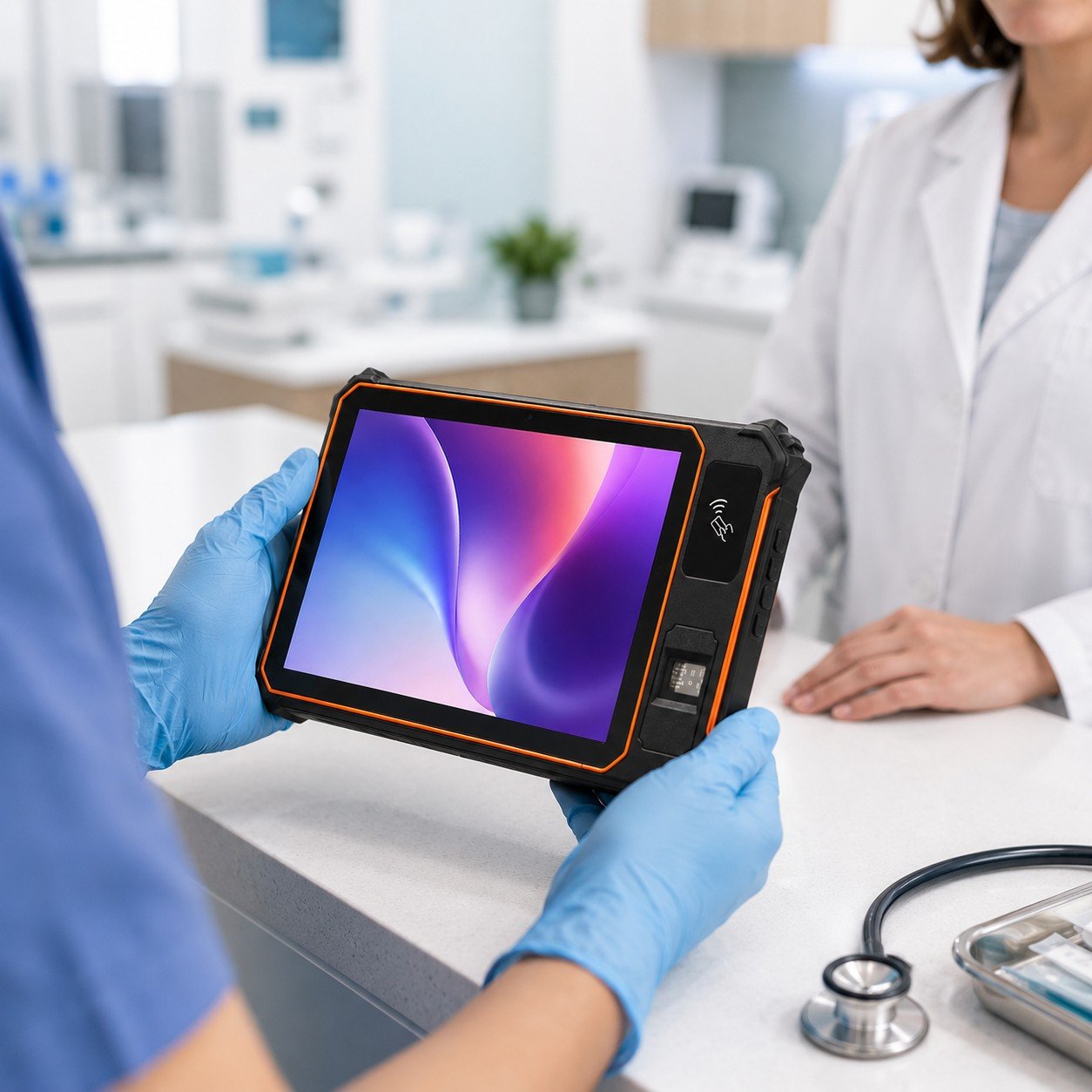
The short answer: a rugged case does not make a consumer tablet a medical device
A consumer tablet in a rugged case changes ingress and impact protection only. It does not create an IEC 60601-1 electrical-safety file, an IEC 60601-1-2 EMC report, or wipe-tolerance evidence naming the exact model and configuration — so it cannot be documented as medical electrical equipment, and it will not clear a hospital tender that asks for those reports.
That verdict has a boundary, and the boundary matters more than the verdict. Whether a tablet is a medical device is decided by its intended purpose, not by its shell. As SCN’s guide to IEC 60601-1 puts it, under the EU Medical Device Regulation (EU) 2017/745 the manufacturer’s intended purpose decides whether something is a medical device — a panel PC used for patient records or at a nurses’ station is usually not one, even when it is certified to IEC 60601-1 (scn.eu).
So shortlisting produces one of three outcomes, and you should decide which one your project is before you open any supplier file:
- Consumer tablet, non-clinical admin use. Accepted only if the device never enters a clinical intended-purpose statement, is not used at the point of care, and your own risk assessment documents the limits. Sign-off: hospital IT plus clinical safety, not procurement alone.
- Medical-grade tablet, point of care. Accepted when model-specific 60601-1 and 60601-1-2 reports exist at current editions, the certified configuration matches your bill of materials, and wipe-tolerance evidence is produced. Sign-off: quality/regulatory, usually with a declaration of conformity on file.
- No acceptance. The most common outcome for a consumer device marketed as “hospital ready” without a report behind the phrase.
Everything below is the shortlisting filter. Each checklist item is designed to disqualify a candidate early — cheaply, on paper — rather than after award.
Checklist 1 — Split the two standards before you read a single report
Buyers lose time because suppliers present “60601” as one thing. It is two, and they answer different questions.
| Standard | What it constrains | What you are actually buying |
|---|---|---|
| IEC 60601-1 (general standard) | Basic safety and essential performance: electric shock, mechanical hazards, temperature, enclosure, single-fault conditions | Evidence the device is electrically and mechanically safe in normal and single-fault conditions |
| IEC 60601-1-2 (collateral standard, EMC) | Emissions and immunity: radiated and conducted emissions, ESD, radiated RF fields, fast transients, surges | Evidence the device neither disturbs nor is disturbed by other equipment in the declared use environment |
In most cases both are required. MedDeviceGuide states plainly that IEC 60601-1-2 is a collateral standard applied alongside the general standard, and that both safety testing and EMC testing are required for regulatory submission in the FDA, EU and most other markets (meddeviceguide.com). Its guide also notes that the FDA recognises ANSI/AAMI ES60601-1 as the US-adopted consensus standard and that the FDA ASCA programme can streamline acceptance of results from qualified laboratories.
Two edition checks decide whether the file is usable:
- Read the edition printed on the report, not the one quoted in the sales deck. SCN’s guide identifies IEC 60601-1-2 edition 4.1 (2020) as the current version; the Johner Institute recommends using Amendment 1, i.e. edition 4.1 (blog.johner-institute.com). Element’s summary of the fourth edition’s EU listing notes that products remaining in production after the mandatory effective date may require redesign, and that even where no design change is needed, testing must be performed (elementdefense.com).
- Confirm the declared use environment. 60601-1-2 requirements are classified as professional healthcare facility, home healthcare or special environment, with home use carrying higher immunity requirements (SCN). If your rollout includes community nursing or home-care visits, a professional-facility-only report does not cover it.
For emissions, Element lists the applicable pieces: conducted and radiated emissions using the limits and methods of CISPR 11, harmonic distortion to IEC 61000-3-2, and voltage fluctuation and flicker to IEC 61000-3-3 — with the application of the latter two depending on the use environment. That is the vocabulary to use when you ask a supplier what their report covers.
Checklist 2 — “The battery has a 60601 report” is not whole-device compliance
This is the single most common failure in a shortlist, and it is usually presented in good faith. A component report for a cell, battery pack or power adapter is an input to the tablet manufacturer’s risk file. It is not a certificate for the tablet, and it cannot be substituted for one in a tender response.
Use this sequence when the pack lands on your desk — it is also the order a hospital compliance reviewer tends to work in:
- Report front page first. Read the equipment-under-test field. It must name the tablet model and any variant list. If it names a battery part number, an adapter or a “typical representative sample” without a model list, stop there.
- Standard edition and clause scope next. Which edition of IEC 60601-1 and IEC 60601-1-2 is printed, and is the collateral standard present at all?
- Then the deviations and exceptions annex. A report listing deviations is more useful than a clean-looking one-page summary, because your reviewer can see the actual gap.
- Then configuration. Does the EUT description include the mains adapter actually shipped, the enclosure, and any dock or charging cradle in the quoted BOM?
- Then the process evidence. Ask whether an EMC test plan with per-function pass/fail criteria existed before testing.
On that last point, Element’s explanation of Annex F is the cleanest public description: 60601-1-2 requires risks from electromagnetic disturbances to be handled inside the ISO 14971 risk management process, Annex F gives guidance for doing so, and the resulting risk management report provides the pass/fail criteria for each product function and how basic safety and essential performance will be monitored during each immunity test — information that feeds the EMC test plan, which is required before testing starts. A supplier who can produce that plan is a supplier with a process, not a supplier with a PDF.
Finally, test the language. “Designed to meet”, “compliance-ready design”, “built to 60601 standards” are not evidence. Only a report from an accredited laboratory counts — an NRTL in the US or a notified-body-accredited laboratory in the EU, per MedDeviceGuide.
Checklist 3 — Confirm the certified configuration matches the quote
Certification attaches to a configuration. Procurement attaches to a BOM. Your job on the shortlist is to prove the two are the same object.
Accessories that can move a device outside its tested configuration include third-party USB-C power supplies, aftermarket rugged cases, screen protectors that alter thermal behaviour, hand straps, barcode scanners, cartridge or expansion modules, vehicle docks and charging cradles. For each item in your BOM, ask the supplier to state in writing whether it is listed in the test report and risk file, or is a post-certification accessory. If it is post-certification, the manufacturer owes its own change assessment — put that in the tender clarification now, not in an implementation meeting after award.
There is a second configuration trap that gets missed: the connection question. If the tablet becomes part of a medical electrical system wired to other ME equipment, responsibility for system-level 60601-1 compliance shifts to whoever assembles that system. If your integration partner builds a cart or wall station around the tablet, name that party in the contract.
If your shortlisted configuration will be locked down — kiosk mode, fixed app set, no consumer store access — raise it in the same conversation as the compliance file, because managed deployment settings interact with what the device is certified and supported to do. Our notes on Google Play developer verification and enterprise sideloading cover how that deployment model is handled on Android business tablets.
Checklist 4 — How a cleaning and disinfection claim should actually read
The requirement exists in the standard: IEC 60601-1 states that manufacturers must have considered the impact of multiple cleanings and disinfections, and devices go through reprocessing according to their instructions for use as part of compliance testing (testlabsuk.com). A single “alcohol-safe housing” sentence is not a substitute for that work.
Demand four fields per reagent, in writing:
- Reagent family and active concentration — not a brand name alone.
- Contact time as tested, which is often shorter than the ward’s actual dwell time.
- Number of wipe cycles tested, cumulative.
- What was assessed after cycling — device function, enclosure crazing and stress-cracking, label and marking legibility, touch response, gasket condition, and ingress protection re-verified after cycling.
Request each reagent family separately, because one passing wipe does not imply the others. The four that appear in real ward practice are alcohol (ethanol or isopropanol), quaternary ammonium compounds, chlorine-releasing wipes, and hydrogen peroxide — the same families SCN’s guide names when it advises buyers to ask which disinfectants and concentrations the housing has been tested with.
Two claims to handle carefully. First, antibacterial surface treatments suppress bacterial growth on the surface but never replace cleaning (SCN) — treat them as a nice-to-have, not a compliance answer. Second, check whether the tested reagent list appears in the instructions for use. If the IFU does not carry it, ward staff have no controlled list to follow and your cleaning SOP is unenforceable.
Checklist 5 — IP rating is not disinfection tolerance
IP and chemical resistance are different evidence types, and conflating them is where tender responses get inflated.
An IP rating is an ingress test against IEC 60529 — dust and water. Chemical resistance to repeated wiping is a materials-compatibility question with no IP equivalent. Silicone gaskets that hold IP68 can still swell under a solvent; polycarbonate can craze; screen-bond adhesives can fail; printed legends can lift; chlorine can yellow a housing. None of those failures shows up in an IP test.
Use IP as a floor, not a finish line: a high IP rating tells you a splash or a washdown will not kill the unit. It tells you nothing about the wipe cycles in your cleaning protocol. The question to ask is precise: what IP rating, tested to which edition of IEC 60529, on which enclosure configuration — and was IP re-verified after the wipe-cycling test? That last clause separates a materials programme from a datasheet bullet.
Checklist 6 — Ten questions to paste into your RFQ or tender clarification
These are written for nurses’ station, mobile rounding and pharmacy deployments, and each expects a specific answer format rather than a narrative.
- Model and configuration: which exact model, and which configuration, does the compliance file cover — and does that configuration match our quoted BOM? (Answer: report front page, PDF.)
- Standard editions: which editions of IEC 60601-1 and IEC 60601-1-2 are covered, and is 60601-1-2 edition 4.1 included? (Answer: clause and edition on the report.)
- Power adapter: is the mains adapter we will receive included in the EUT description? (Answer: yes/no plus the EUT page.)
- Component claims: does any part of your compliance position rest on a component-level report — battery, adapter, panel? (Answer: written statement.)
- Accessories: are the case, dock, scanner or vehicle mount in our BOM inside the certified configuration, and who re-assesses if we add one? (Answer: named responsible party.)
- Cleaning: reagent list with concentrations, contact times and cycle counts, plus post-cycle functional checks. (Answer: test summary table.)
- IFU: is the tested cleaning-agent list reproduced in the instructions for use? (Answer: the page.)
- Ingress: IP rating, IEC 60529 edition, enclosure configuration, and post-cycling re-verification. (Answer: test report scope.)
- Lifecycle: battery cycle life, expected replacement interval, spare-parts availability, and the operating-system and security-patch commitment across your planned deployment life. (Answer: written commitment, not a roadmap slide.)
- Legal manufacturer: who is the legal manufacturer of record for the EU, and who is the US agent — and can either supply a declaration of conformity on request? (Answer: named entities.)
Checklist 7 — Red flags in the file pack, and what to do when nothing exists
The red flags are consistent across tenders: certificates with no model number on them; reports lifted from a different product line; superseded standard editions presented as current; “compliance statement” letters with no laboratory name; cleaning lists that name no concentration and no contact time.
When a supplier genuinely has no 60601 file, you still have options — but they are narrower than sales teams suggest. Run a documented internal risk assessment for a strictly non-clinical use case, keep the device off mains charging at the bedside, and exclude it from any intended-purpose statement that would push it into medical-device territory. Record the decision. An undocumented “we accepted it anyway” is the finding an auditor writes up.
When the evidence is partial, change the question. Ask for the deviations annex, ask which items in the risk file were carried over from a predecessor model, and ask for the EMC test plan. If you commission your own verification, scope it honestly: accredited-laboratory safety and EMC testing is a programme cost, not a sample fee. Budget it as an NRE line in the tender, not as a surprise in month four. And treat any consumer-grade tablet marketed as “hospital ready” without a test summary as unverified — public wipe-cycle durability data for consumer tablets is thin, so the absence of a document is the finding, not a pause in the conversation.
The same documentation discipline applies to public-sector and defence-adjacent tenders, where certification claims sit alongside sourcing restrictions; our TAA/NDAA 889 rugged tablet documentation checklist sets out how the paper trail is assembled for that class of requirement.
Build the shortlist: the file pack that ends the argument
The acceptance set is small and specific. Model-specific IEC 60601-1 and IEC 60601-1-2 reports at the current editions; a written confirmation that the EUT and configuration match your BOM; a wipe-tolerance summary covering the four reagent families with concentrations, contact times and cycle counts; IP verification to a stated IEC 60529 edition, re-checked after cycling; and a named legal manufacturer with a declaration of conformity available on request.
That is the package that turns a compliance argument into a procurement decision. For Android configurations built with these requirements in mind — IP-rated enclosures, wipe-down housings and business-grade deployment controls — start with our 11.97-inch Snapdragon 685 business tablet and the WT8662 tablet platform, both of which can be quoted against a defined accessory BOM so the certified configuration question is resolved before you compare prices.
Request the medical-scenario compliance file pack and the wipe-tolerance test summary for the model you are shortlisting, together with a sample unit for ward-side wipe evaluation against your own cleaning agents. Tell us the intended use, the deployment environment and the accessories in your BOM, and the file pack can be assembled against your tender questions rather than a generic datasheet.
Questions buyers ask after the file pack arrives
Can I use a normal Android tablet in a hospital if I put it in a medical-grade case?
A case changes ingress and impact protection. It does not produce a 60601-1 report, a 60601-1-2 EMC report, or wipe-tolerance evidence for the tablet — so the combination cannot be documented as medical electrical equipment. It may be acceptable for strictly non-clinical administrative use under your own risk assessment.
Does IEC 60601-1 apply to a tablet used at a nurses’ station for patient records?
Whether the device is a medical device follows from its intended purpose, not from certification. A device used for patient records at a nurses’ station is usually not a medical device even when it carries 60601-1 certification; certification shows electrical safety and EMC testing for healthcare, which is a separate question from device classification.
Is a battery-level 60601 report enough to certify the whole tablet?
No. A component report is an input to the manufacturer’s risk file. The report you need names the tablet model and configuration in its equipment-under-test field and includes the mains adapter you will actually receive.
How many wipe cycles should a medical tablet be tested for, and with which disinfectants?
The standard requires the impact of multiple cleaning and disinfection cycles to have been considered; it does not give you a single universal cycle count to quote in a tender. Ask the supplier for the cycle count they tested, the reagent families and concentrations, the contact times, and the post-cycle checks — then compare that scope against your own ward protocol.
Does an IP65 or IP68 rating mean the tablet is disinfection-proof?
No. IP is an ingress test to IEC 60529 covering dust and water. Chemical resistance to repeated wiping is a separate materials question, and a high IP rating says nothing about how the housing behaves after repeated quaternary ammonium or chlorine exposure.